Lighting & string lights · Photo Listicle ·
27+ Landscape Lighting Ideas That Will Make Your Neighbors Stop
Affiliate disclosure · Earthwork earns commission on some links
The yard you spent ten months planning gets photographed once — in the daylight. Then it goes dark at 8 pm and nobody sees it. Landscape lighting is the move that takes the design from a day-only object to something that pulls you out the back door at 9 in the evening.
Here are 27 landscape lighting ideas, weighted toward what actually works after dark instead of what looks good in the catalog. Wattages are listed, color temperatures are specified (this matters more than you'd think), and the fixture-quality recommendation is honest: cheap solar fixtures are a waste; wired LED systems are the right answer for a yard you intend to use.
Start with one transformer at the side of the house
A 300-watt low-voltage transformer (Volt, Kichler, FX Luminaire) wired to the house's electrical panel, mounted at the side of the house under an eave. Every landscape light gets daisy-chained back to this transformer through 12-gauge direct-burial cable. Cost: $250 to $450 for the transformer, $0.45 per foot for the cable. The transformer is the one-time decision that simplifies every later install.
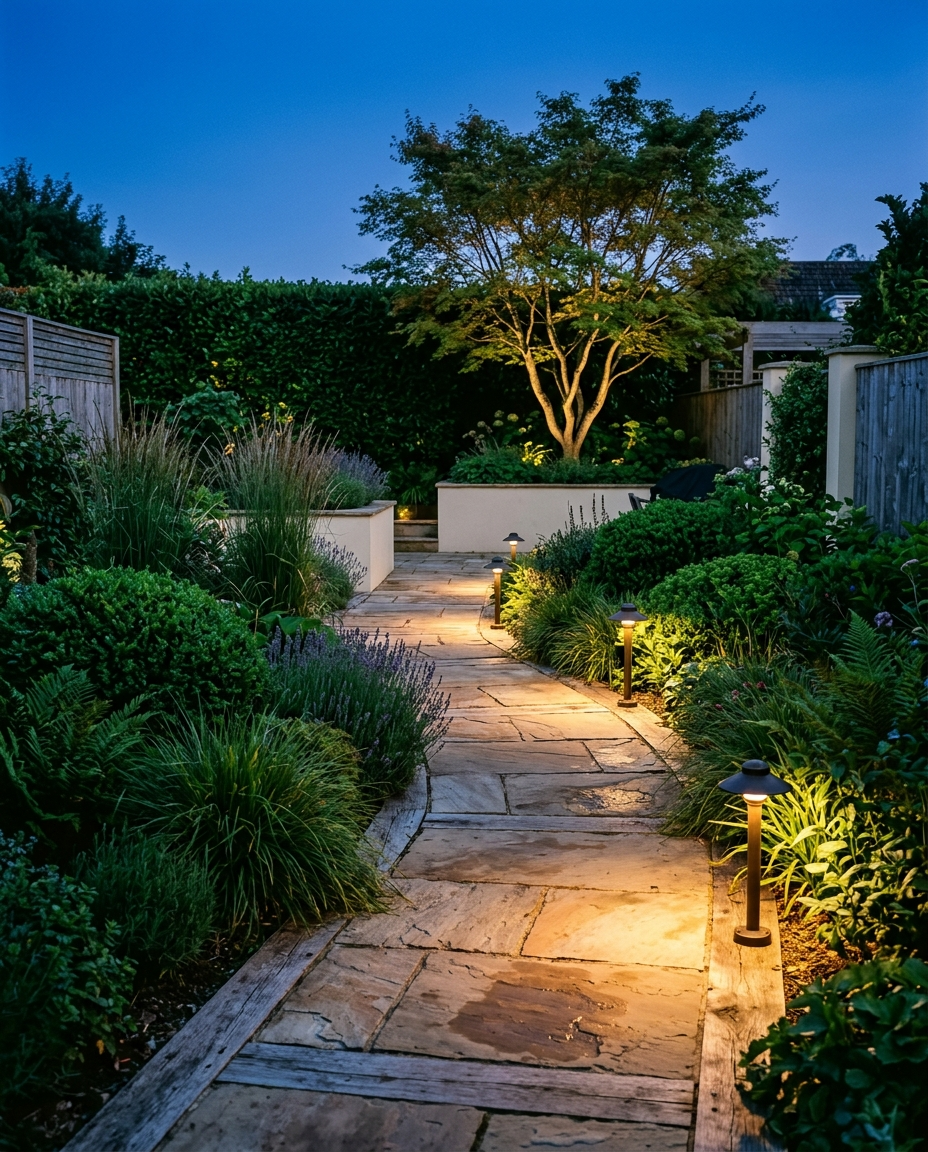
Path bollards, low-glare warm white
3-watt warm-white (2700K) LED path bollards, spaced 6 to 8 feet apart down both sides of a walkway, set 6 inches off the path edge. Brass or oil-rubbed-bronze housings hold up across 10 years of weather. Skip the matte black powder-coat finish — it flakes after 4 to 5 years. About $40 to $80 per fixture for residential-grade, $120 to $200 for commercial-grade.
Uplight the specimen tree
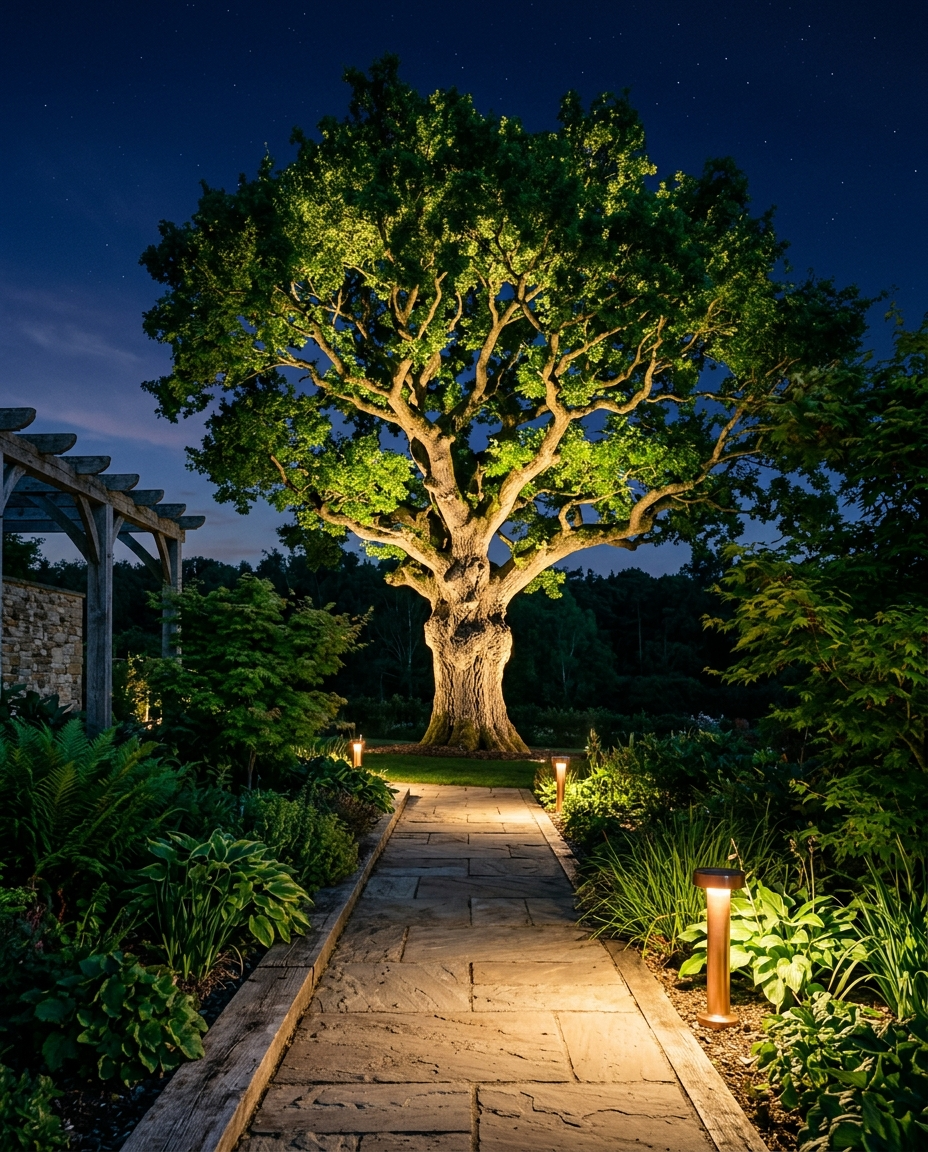
A 7-watt narrow-beam (15° to 25°) LED spotlight set in the ground 18 to 24 inches from the trunk, aimed up at the canopy. The light grazes the bark texture and lights the leaves from below. For a 20-foot tree, two fixtures (one on either side of the trunk) handle it. Reads as drama; almost no other landscape lighting move does as much for as little.
Path stones with downlight from low overhead
Mount 3-watt downlight fixtures to a pergola or low garden structure, aimed straight down at stepping stones at 6 to 8 foot intervals. The cast-down light pattern reveals the stones as discrete spots rather than a continuous strip. Best when the path runs under existing pergolas, deck overhangs, or wide-canopied trees.
Wall-wash on a stone retaining wall
A 5-watt linear LED strip mounted to the underside of a wall cap, washing light down the stone face. Reveals the texture of the wall after dark; doubles as a soft path-edge wash. About $25 per linear foot for the LED strip plus low-voltage transformer capacity.
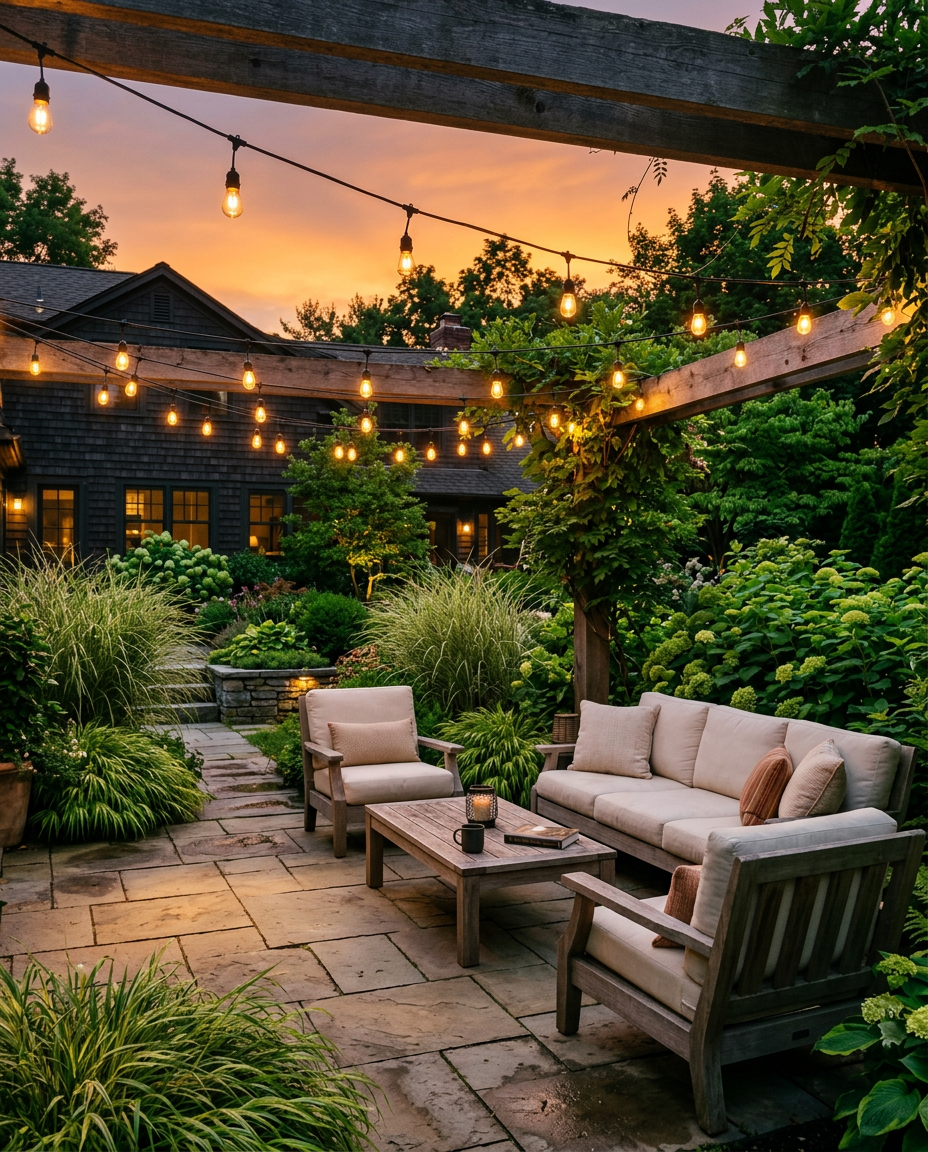
Café string lights at 8 to 9 feet
24 to 48 feet of string lights with 2700K Edison-bulb LEDs (Brightech, Hometown Evolution, or Newhouse Lighting brands all hold up). Hang on a single wire from house to back pergola or fence post. The right height is 8 to 9 feet — low enough to read as a ceiling, high enough to walk under without ducking. Total cost: $80 to $200 for the lights plus a wall outlet.
Step lights on the deck
Recessed 1-watt LED step lights set into the riser of every other step, low enough to mark the tread edge without blinding the eye line. Wired to the same low-voltage circuit as the path lights. About $35 to $65 per fixture, plus the installer's labor to mount each.
Moonlight: downlight from high in a tree
A 7-watt LED spotlight mounted 25 to 35 feet up in a mature tree, aimed down at the planted bed or lawn below. The light pattern dapples through the leaves like moonlight on a clear night. Mounted with a vinyl-coated tree clamp (no nails, no straps that girdle the trunk). The most romantic landscape lighting move, and the easiest to overdo — one per yard, not three.
Underwater pool lighting at 2700K
Skip the color-changing pool LEDs. Replace with 5- to 12-watt warm-white (2700K) LED bulbs that fit standard pool light fixtures. Pool water reads as amber-glass at night instead of swimming-pool blue. About $80 to $200 per bulb retrofit; $400 to $800 if rewiring a complete fixture.
The dark-sky-friendly install
If you're in a dark-sky zone (or have neighbors who care), use fixtures with full-cutoff shielding so light goes down, not out. Bollards with shrouded tops, downlight-only spots on trees, no fixtures aimed above horizontal. Most quality residential brands have full-cutoff options; cheap fixtures don't.
Fire and electric layered together
A wood-burning or gas fire feature provides flickering warm light at chest level; the rest of the yard's LED lighting handles spatial cues at ankle and overhead level. The two layers together produce a richer night yard than either alone. The fire pit designs hub covers the fire-feature half.
Warm-white only, every fixture
The mistake that ruins more landscape lighting installs than any other: mixing color temperatures. Use 2700K (warm white) on every fixture in the yard. Anything cooler (3000K, 3500K, 4000K) reads as commercial parking-lot or hospital. Anything warmer (2200K) reads as candle-orange and clashes with normal-spec interior lighting bleeding out the windows.
Skip the solar stake lights
Solar stake lights have a useful life of 8 to 16 months before the battery degrades to uselessness. The 4-watt solar version of a $35 wired bollard is $12 at the hardware store and lasts a year. Once you've replaced them twice you've paid more than the wired version costs.
Smart control via app
A WiFi or Bluetooth-enabled transformer (FX Luminaire ZDC, Kichler ENO) plus a smartphone app to set on/off schedules, scenes, and dimming levels per zone. Adds about $400 to $700 to the transformer cost. Worth it for yards over 1,500 sq ft with three or more lighting zones; overkill for a single-zone install.
How to budget your landscape lighting install
For a 1,000 sq ft yard: - DIY low-voltage with 6 to 8 fixtures: $400 to $800 - Pro install, 12 to 18 fixtures, single transformer: $2,800 to $5,500 - Pro install, 20+ fixtures, multiple zones, smart control: $7,000 to $14,000
The fixture quality matters more than the fixture count. Eight quality brass fixtures last 15 years; eighteen cheap aluminum fixtures last 3. The right move is fewer-and-better.
FAQ
Frequently asked questions
What's the most important landscape lighting idea for curb appeal?
Two uplights on a specimen tree near the front of the house. One move, drama, three minutes to install if you have an outdoor outlet. The single highest landscape-lighting ROI you can make.
What color temperature is best for landscape lighting?
2700K warm white. Period. Cooler reads as commercial; warmer reads as candle. Match every fixture in the yard to 2700K.
How long do LED landscape lights last?
Quality brass-housing LED fixtures: 12 to 20 years. The LED itself: 35,000 to 50,000 hours (about 10 to 15 years at residential use rates). Cheap aluminum housings corrode in 3 to 5 years in salt-air or freeze-thaw climates.
Do I need a permit for landscape lighting?
Usually no for low-voltage (12V) systems wired to a transformer plugged into an existing outdoor outlet. Yes if you're adding new electrical circuits, running line-voltage (120V) lighting, or trenching across property lines. Pull a permit if your municipality requires one — it protects the install for resale.
Can I install landscape lighting myself?
Yes for low-voltage residential systems. The wiring is shock-safe, the transformer plugs into an outdoor outlet, and the fixtures connect with twist-lock connectors. Plan for one weekend per 8 to 12 fixtures. Hire out if you want a multi-zone transformer install or any line-voltage work.
These 27 landscape lighting ideas reward restraint. The yard that looks best at night is the one where you can identify the lights individually — a path bollard there, an uplit tree there, a string of café lights overhead. The yard that looks worst is the one with 40 fixtures all pointed everywhere at once. Pick six to twelve placements, commit warm-white across all of them, and let the dark spaces between do their own work.