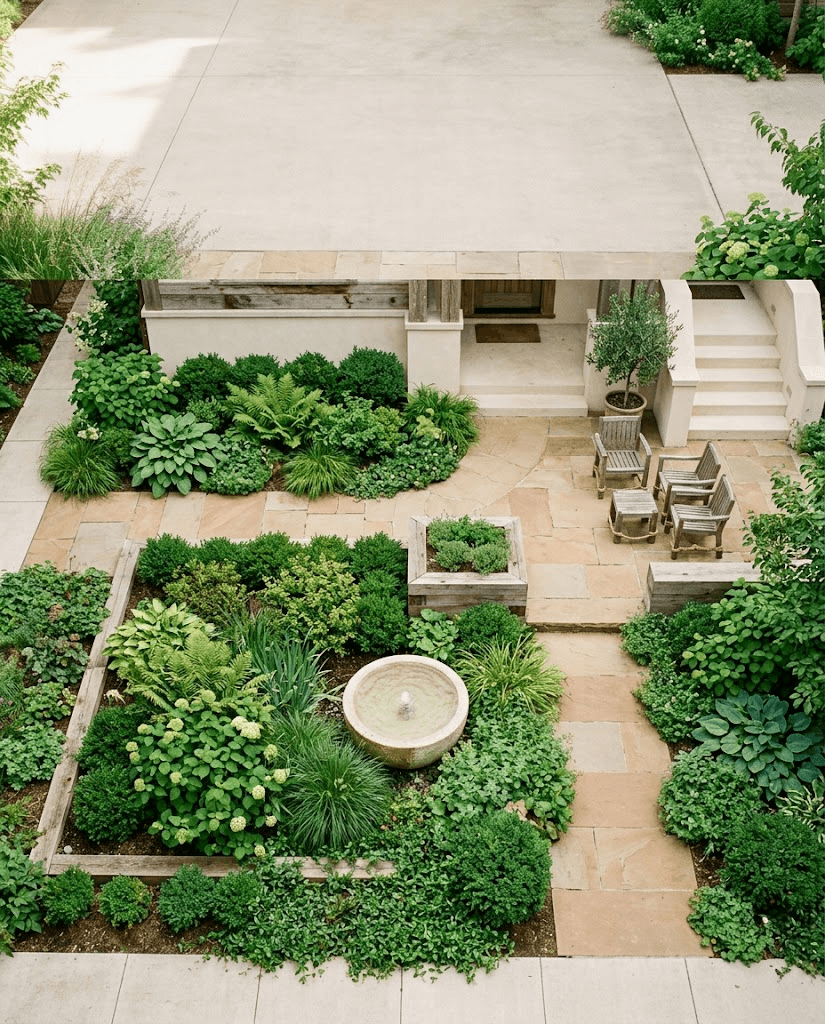
Front yard landscaping · Photo Listicle ·
31+ Front Yard Landscaping Ideas That Will Make Your Neighbors Stop
Affiliate disclosure · Earthwork earns commission on some links
The front yard is the only one most visitors will ever see. It's also the part of the yard most homeowners skip — beds get tired, the lawn edge wanders, the foundation planting from 2008 has eaten the porch. Here are 31 front yard landscaping ideas that fix the scene without rebuilding from scratch.
Each one is something you can do in a weekend or plan for a season. Plant lists are specific (no "add some shrubs" hand-waves). Costs assume retail pricing at Home Depot or Lowe's, plus the kind of mulch and edging you'd actually buy in person.
Start with the foundation bed reset
Pull everything six feet of the house planted before 2015. The yews are tired, the boxwood probably has volutella, and the hostas have crept into the lawn. Re-edge the bed with a square spade so the line is crisp. Re-mulch at three inches with hardwood, not dyed. The planting that goes in matters less than the geometry of the bed itself — a clean curve and a deep mulch line do 70% of the curb-appeal work before you put a single shrub in.
Build a low stone border along the lawn edge
A six-inch stacked-stone border between lawn and bed reads as intentional in a way a plastic edging never will. Use Pennsylvania bluestone scraps for the East Coast look or Arizona flagstone for the Southwest. Set them dry on a two-inch sand bed, no mortar, no permits, and you can pull them out next spring if you change your mind. More edging variations live in our flower beds & borders hub.
Anchor the entry with a single specimen tree
One Japanese maple ('Bloodgood' or 'Crimson Queen') beats five small shrubs every time. Plant it 10 to 12 feet off the front corner of the house so the canopy frames the entry without blocking it. Mature size: 15-20 feet. USDA zones 5-8.
Run a stepping-stone path off the driveway
Most homes have a useless strip between the driveway and the front door. A stepping-stone run through that strip, Tennessee fieldstone or thermal-finished bluestone set 22 inches center-to-center, turns it into the welcome path everyone actually uses. Mulch the gaps or fill with creeping thyme for the cottage version.
Plant a mass of one perennial, not five different ones
Twelve catmint ('Walker's Low') reads as one design move. Two of catmint, two of salvia, two of coneflower, and two of yarrow reads as a clearance-rack haul from your local nursery. Pick one and commit to a sweep of nine to fifteen plants on three-foot centers.
Add evergreen structure that holds the bed in winter
The front yard is the one bed that has to look intentional in February. Three matched 'Densiformis' yews behind a row of liriope, or two boxwood balls on either side of the front step, or a single inkberry holly as a backbone. Pick one structure plant and use it twice or three times. Never just once.
Light the path with low-glare bollard lighting
Skip the spike-stake solar lights from the big-box garden center. They lean drunk by August. Instead: a four-pack of brass or oil-rubbed bronze bollards (Volt Lighting and Kichler both make residential-grade options for under $400 a set) wired to a transformer at the side of the house. The light should pool on the path, not blast at the neighbors.
Soften the driveway edge with a low, repeating planting
Six lavenders or six dwarf nepeta down the side of the driveway, set 24 inches apart. They take heat reflection from the asphalt, smell good when you walk past, and bloom from May through October. The repetition is the design.
Frame the front door with two matched planters
Two large planters (24 inches or bigger, since anything smaller looks fussy on a residential porch) flanking the front door. Plant them with one structural plant — a small boxwood or a topiary rosemary — and let them sit there for three seasons. Swap the underplanting with the season: pansies in spring, calibrachoa in summer, mums and ornamental kale in fall.
Replace turf with a no-mow ground cover
If your front yard sees less than four hours of direct sun, the lawn there is a losing battle. Pull it. Plant a sweep of Pachysandra terminalis or Vinca minor on 12-inch centers. Three years in, it's a continuous green carpet that asks for nothing but a single fall cleanup. The mulch & ground cover hub has more shade-tolerant options.
Stake out a curved bed line, then follow it
Lay a garden hose where you want the bed line to go, walk the property to the street, look at it from the upstairs windows, drive past it twice. Sleep on it. Then cut the bed. Most foundation beds are too narrow because someone in a hurry cut the line at the eight-foot mark and walked away. Yours should be at least six feet deep where it counts.
Add a dwarf flowering tree on the lot line
A 'Cleveland Select' pear or a serviceberry between you and the neighbor reads as a generous gesture, gives you screening from May through October, and earns its place again in fall when it turns. Plant it a third of the way down the property line so you don't end up with two matching trees on either side of the same fence.
Put a low picket fence at the sidewalk, the colonial move
Three feet, white, hand-tipped. It reads as historical even on a 1998 colonial. Add a gate centered on the front walk. Plant catmint or boxwood inside the line. The fence does the framing work that beds alone can't.
Layer your bed by eye level
The front bed should drop from house-side to sidewalk-side: a four-to-six-foot shrub at the back, an 18-to-30-inch perennial in the middle, a six-inch ground cover at the front. If it's flat (all 30-inch hostas, say) it reads as a hedge. If it stair-steps, it reads as designed.
Skip the colored mulch
Hardwood mulch is the field-guide answer. Brown-black aged hardwood from a local landscape supply, not the dyed black bags from a hardware store. Two-and-a-half to three inches deep, refreshed every spring. Dyed mulch reads as the parking lot of an Applebee's.
Add a low water feature only if you'll maintain it
A 24-inch ceramic bowl with a single bubbler is enough. Anything bigger, and you're committing to a pump replacement every three years and a winter-drain ritual. The sound matters more than the volume of water.
Run a flagstone walkway from sidewalk to front door
If your existing concrete walk is cracked, replace it with full-thickness flagstone (1.5-2 inches), four feet wide. Set on a compacted base of four inches of crushed stone and one inch of stone dust. Pricier than a poured pour, but it's the move that ages well across decades. The pavers & hardscape hub has the full hardscape menu.
Use one ornamental grass for late-season movement
A row of three 'Karl Foerster' feather reed grass at the back of the bed. Stays vertical, turns wheat-gold by August, holds through the first snow. The movement on a windy afternoon is the point.
Underplant the specimen tree
The bare circle of mulch under a Japanese maple is a missed opportunity. Plant epimedium, hellebores, or 'Sum and Substance' hosta in a 24-inch ring around the trunk. Match the underplanting to the tree's mature canopy width, not its current width.
How to budget a front yard refresh
For under $500: re-edge, re-mulch, replace one tired shrub with one specimen, add two flanking planters. That's the weekend project.
For $500 to $1,500: add the stone border, replace the foundation planting, install path lighting, add a mass-planted perennial sweep.
For $2,000 to $5,000: stepping-stone path, specimen tree, low picket fence, a designer-grade planting plan instead of nursery-aisle improvisation.
Most homeowners overshoot by trying to do all three tiers at once. Pick the tier that fits the calendar this year and the next, and stage the rest.
FAQ
Frequently asked questions
What's the cheapest front yard landscaping idea that still looks expensive?
Re-edge and re-mulch. A clean spade-cut bed line and three inches of fresh hardwood mulch will lift the whole front of the house for under $80 in materials and one Saturday morning of labor.
How many plants do I need for the front foundation bed?
For a 20-foot front bed, plan on three to five structural shrubs (3-4 feet wide at maturity), nine to fifteen mid-layer perennials (24 inches on center), and a continuous front-edge ground cover. That's roughly 25-35 plants total, not the 75 a nursery walk-through will sell you.
What's the best low-maintenance front yard plant for full sun?
Catmint 'Walker's Low' for the perennial layer, plus 'Densiformis' yew or inkberry holly for the structural layer. Both are zone 5-9, take heat, and need almost no water once established.
Do I need to remove old mulch before adding new?
Not the whole layer. Rake the old mulch flat and add an inch or two on top until you hit a 2.5-3 inch total depth. Pull and replace only if it's matted, smells sour, or has a thick layer of fungal growth.
Should I plant my front yard in spring or fall?
Fall, every time. The soil is still warm, the roots establish before winter, and the plants come out of the gate in spring already settled. Spring planting works but you're watering hard for the first six weeks.
These front yard landscaping ideas all share one thing: they reward patience. Pick three this year, three more next, and by the end of the second season you'll have something that pulls the eye from the curb instead of asking forgiveness for the last decade of deferred maintenance.